
The F Word
Think Tanks Lie About Economic Freedom And Risk the End of the World For Everyone

Let us dispense with the idea that everyone agrees on the definition of freedom. Some folks use a very reductionist definition, which says that freedom is about doing whatever you feel like doing and having no restrictions imposed on you from anywhere including government, other humans, or nature. Other folks use more nuanced definitions for freedom which consider natural limits, social limits, and even self-imposed limits to what you can do.
Today we will see how lying about freedom makes the world more dangerous. Is there anything to do about it?
Welcome to the Fraser Institute, everyone: the top think-tank in Canada, headquartered in Vancouver, ranked in the top 15 among all think-tanks worldwide. This alone should be impressive enough. Fraser produces research on taxation, health care, aboriginal issues, education, economic freedom, energy, natural resources and the environment. This research is peer-reviewed and overseen by an Editorial Advisory Board of leading international scholars, so they say.
So far so good. Let’s see some of that research, specifically about everyone’s favorite subject: economic freedom. The author is Matthew Mitchell, a senior fellow at Fraser. To have an idea about Mitchell, here are some titles of articles he published recently: Canadians right to worry about ‘big government’ agenda or Industrial Policy in 2024—another term for socialism?
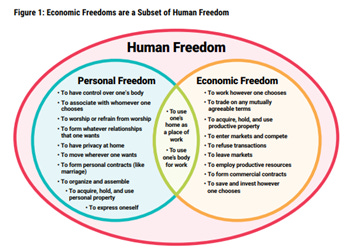
Mitchell attempts to define economic freedom by showing a diagram and explaining that economic freedom is a spectrum of many things, from choosing, trading, acquiring property, competing on markets, enter contracts, saving and investing.
Wise men, starting from 1984 at a Mont Pelerin Society meeting, decided it was about time that economic freedom was measured and was given a number, so countries can be placed in an easy-to-read hierarchy. This is how the Economic Freedom of the World index was born. We can easily see how Singapore is doing quite well at number 1, and Venezuela is doing quite badly in the 165th place.
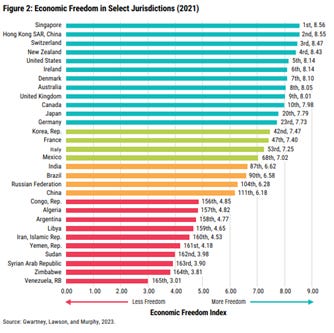
What is in this economic freedom index? (1) The size of government, which actually means how much government spends (2) legal system and property rights, meaning if your property is secure after you buy it (3) sound money, meaning if government creates unexpected inflation (4) freedom to trade internationally, meaning when a government imposes tariffs on imports and (5) regulation on how business can enter markets, including credit markets.
Every single item on this list has serious flaws and embeds many lies. We’ll come back to unpack them.
Mitchell writes that the EFW index is successful because it was quoted about 14000 times on Google Scholar, as if the number of citations and popularity are a measure of quality and truth. And it seems many studies find correlation between economic freedom and good outcomes (in blue), mixed outcomes (in green), and bad outcomes (in red).
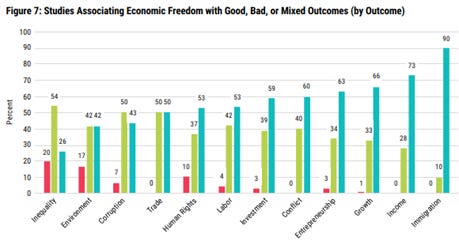
Quick reaction: If the US has such a high score on the economic freedom index, why is the US government so keen on limiting immigration? Fraser Institute doesn’t tell us.
Let’s keep going.
We enter the terrain of flat-out lies. Mitchell writes: “Many thinkers maintain that too much economic freedom is inefficient and that governments can promote prosperity by curtailing economic freedom. Some, like Karl Marx and Friedrich Engels, would abolish nearly all economic freedoms.” There is no citation from Marx or Engels because they never said that, and quite the contrary. Both Marx and Engels were fierce defenders of personal freedoms.
The report paints economic freedom as an idea that allows more gains from trade, more specialization, more competition, more dynamism, allows us to make better use of relevant knowledge. In support of this we see a graph that links economic freedom with average income.
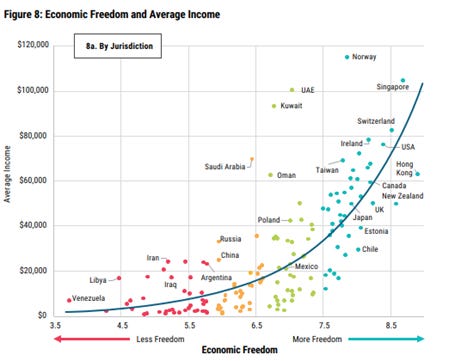
Top right corner is the best place to be. Here we find the USA, Norway, the Swiss. Saudia Arabia which has the economic freedom of a camel in the desert appears to be a relatively rich country with an income of about 70000$ income per person per year.
Next, we see a graph that shows that the least economically free countries have the highest percentage of the population in poverty, shown here in the red column.
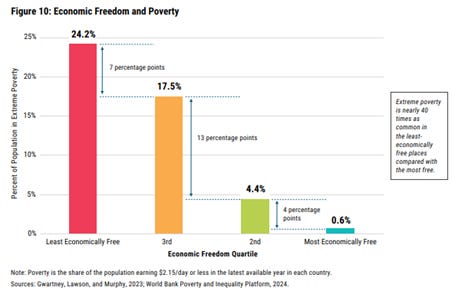
This is beyond insulting for the simple reason that Mitchell does reference the work of economist Thomas Piketty, a world-renowned specialist in economic inequality. So, Mitchell knows about the insane levels of inequality, but he mistakenly, and dare I say it, intentionally suggests that the correlation and causation are the exact opposite from reality. The people in red column, which is 3.4 billion people, are poor because of the economic freedom exercised by corporations of the rich countries. I say it again, economic freedom for the rich, has caused the poverty of half of the humans on Earth.
How does that happen? Workers in South East Asia are paid meager salaries to make t shirts that are sold at high prices in rich countries, miners are dying in Congo while digging up cobalt for the rich countries, corruption and rights abuses are flourishing in lithium mining across Africa, and there are over 4000 more examples from around the world. That enough for you, Fraser Institute?
If the poor countries were actually allowed to have more economic freedom, that would immediately reduce the wealth of the rich countries. How? Pay all workers in all countries a minimum wage of $25 dollars an hour, regardless of the work they do. See what happens next…
The next lie is about economic freedom and average annual working hours per worker.
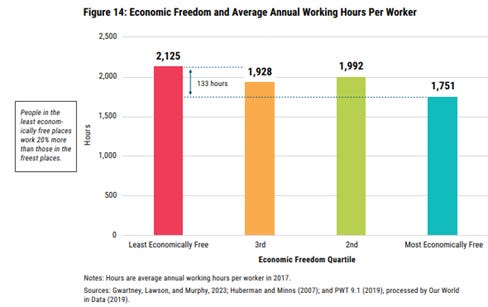
It appears the more economic freedom you have, the less you have to work, according to this graphic. However, they don’t tell us that in the United States, one of the most economically free countries in the world, the gap between productivity and a typical worker’s compensation has increased dramatically since 1979.
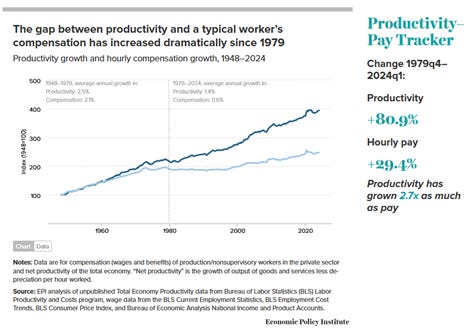
Where did all that money go, while everyone was so “economically free”? To the capital-owning class, obviously, not to the workers who actually did all that work. In the USA alone, the top 1% of Americans have taken $50 trillion from the bottom 90% since 1975. This is how we find out that the so-called economic freedom is not meant for everyone. Mitchell knows it, Fraser knows it, the entire Atlas Network knows it.
More lies from the report link economic freedom to life expectancy at birth, infant mortality, youth literacy rates, self-reported life satisfaction, exposure to air pollution, confusing cause and effect every time.
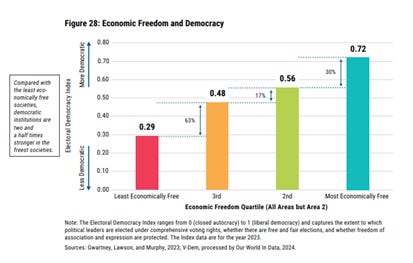
The cherry on top on the cake of economic freedoms is [drumroll]… democracy. It seems that most economically free countries are also the most democratic. Wait, is democracy causing freedom, or is freedom causing democracy? Not even the author knows the answer to this question, yet the suggestion remains that you better have more economic freedom if you want democracy, and you better have a democracy if you want economic freedom. Hold on, what about Saudi Arabia from the graph above? Is it… democratic?
We have built up to a grand reveal about the lies built into the Economic Freedom of the World index and the Mitchell report from the Fraser Institute. Let’s unpack each of the 5 themes that make up the index.
(1) The size of government
Fraser Institute, as any good capitalist, wants as little government intervention into the economy as possible. Specifically, they want government to spend as little as possible. Framing government spending as a bad thing which limits economic freedom is downright manipulative. As I have said/written before, governments that have their own currency do not need to collect taxes in order to spend them on roads, bridges, schools, hospitals, and the army. We learn from Modern Monetary Theory how government budges work. Mitchell doesn’t tell you about MMT, so I will. Goes likes this: governments identify a need in society, issues money to spend on the need and… that’s it.
Taxation is another story. Taxes are not meant primarily for spending, according to MMT. Taxes are primary meant to regulate economic behavior, to incentivize some activities or discourage others. Governments do not need to wait for taxes in order to spend on social programs. The budget of a government doesn’t work like a household budget, or like a corporation’s budget that needs to have a surplus in order to survive. Deficits are a myth. Many governments believe their budgets need to be balanced. Which is wrong, if that is the only objective. Having an economy work at full capacity, which serves the needs of people, is significantly more important than balancing a budget just for the sake of it.
(2) Legal system and property rights
Fraser Institute wants private property protected at all costs, so capitalists can have the guarantee they can use the property to do business. To make all private property sacred, at all costs, does not measure freedom. It measures just that… the sacredness of private property. Is it right to own a river, or a lake, or a forest, or a mountain, or the ocean? Is it right to own other people? Is it right to own the debt of another person, and then sell it?
Mitchell also hides that the economic freedoms of an individual human are NOT the same as the economic freedoms of a corporation. The EFW Index completely ignores that. Specifically, the EFW and the work of the Fraser Institute does not describe how property creates power, how property can become capital often by force in order to serve the interests of corporations, how workers are laid off against their consent. Whose economic freedom is that? It is entirely the freedom of the owners of capital who are defending their property, while workers have no freedom whatsoever.
(3) Sound money / inflation
Fraser Institute thinks inflation is caused by government spending, and that spending limits economic freedom. Governments do not cause inflation! Economists like Milton Friedman have managed to brainwash entire generations of students and politicians with the flawed idea that if governments injected more money into the economy by spending on social programs, that would raise the prices for everything else. These Friedmanites never object if governments spend on the military, or use public money to overthrow foreign governments which were democratically elected. Friedmanites also don’t tell you that it is Loblaw, Metro, Empire, and Pattison that raise food prices, not the government. It is Exxon, Shell, Total, Chevron that raise the prices of gas, not the government.
Inflation happens when there is more money in the economy than its productive capacity. Usually, prices go up when demand doesn’t match with supply. However, inflation happens more often when economic inequality is high. There is always enough money to buy everything produced in the economy, by definition. It is an accounting equivalence. The sellers’ income is the buyers’ expense. When prices go up it is because somebody is greedy, or somebody is taking advantage of some scarcity.
(4) Freedom to Trade
Fraser Institute wants more free trade, which is doing trade between countries, between companies, with as little restrictions as possible, including tariffs. Goods, services, money, capital should be free to travel between countries with as little government oversight as possible.
Free trade is very good according to the neoliberal doctrine. The IMF, the World Bank, the World Trade Organisation, rich countries and multinational corporations have pushed very hard developing countries into free trade starting with the 1970s. Many bilateral and regional free trade agreements have been signed in the name of economic freedom. Unfortunately, during these many years, developing countries have not done well at all, despite listening to those free trade ultimatums. My country of birth, Romania, has suffered terribly under the instructions coming from the IMF in the 1990s, after the fall of communism.
After joining the free trade agreement called NAFTA, during 2001–2005, Mexico’s growth performance has been miserable, with an annual growth rate of per capita income at 0.3%. By contrast, during the import substitution industrialization period (1955–82), Mexico’s per capita income had grown at an average of 3.1% per year, which was much faster than during the NAFTA period. There are so many similar stories you can read here and here.
(5) Regulation
Fraser Institute wants as little regulations as possible. Advocates for unfettered economic freedom love to fight regulations. They cannot stop talking about it. Would any of these ecological disasters have happened if there was more regulation to prevent them?
· The Niger Delta Oil Pollution of 13 million barrels of oil in 1957,
· Ecuador’s Amazon Degradation (1964-1990),
· Peru’s Amazon Degradation (1971-1996),
· Papua New Guinea’s Panguna Mine War (1972-1989),
· Italy’s Seveso Dioxin Cloud (1976),
· France’s Amoco Cadiz Tanker Spill (1978),
· India’s Bhopal Cyanide Gas Leak (1984),
· Chernobyl Nuclear Disaster (1986),
· Exxon Valdez Oil Spill (1989),
· Romania’s Cyanide Spill (2000),
· Ivory Coast’s Toxic Waste Dumping (2006),
· Deepwater Oil Spill (2010),
· Amazon Wildfires (2019-2020),
· Canada’s record-breaking wildfires (2023).
How Lies About Economic Freedom Risk The End Of The World For Everyone?
(1) Corporations emit the most carbon because they are undemocratic
A report from Influence Map shows that 80 percent of global CO2 Emissions come from just 57 companies.
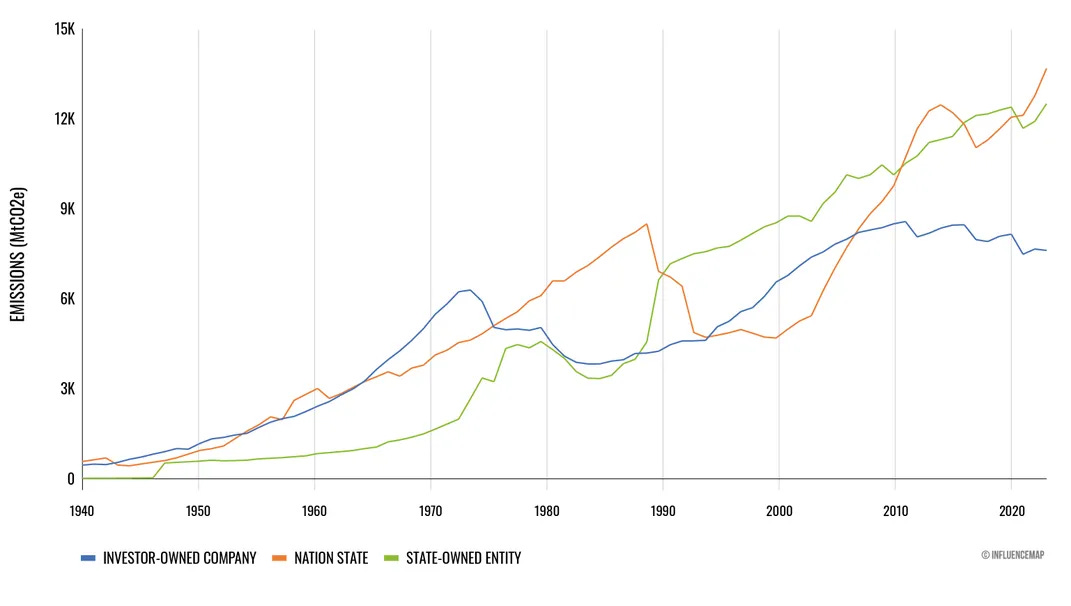
Since the Paris Agreement was signed in 2015, 58 of the top 100 carbon-producing companies have actually increased their production. This is only possible because each one of these companies is a fiefdom of feudalism. I do not mean to exaggerate. While they cry desperately for more freedom, these companies are not democratic. All their decisions are made in the boardrooms at the top, without any consent or opinion from any of their employees, and from any of you not working there. Which is precisely how feudalism worked, with kings at the top of the food chain of power.
(2) Planetary Boundaries Have Been Breached In Both “Free” And “Less Free Countries”
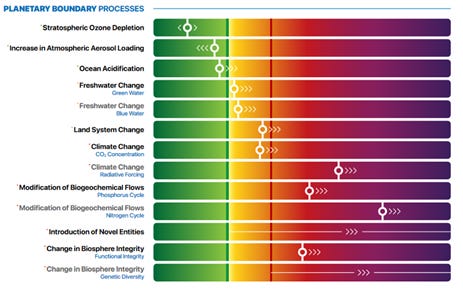
The planetary boundaries framework analyses nine processes and systems that scientifically are proven to regulate the health of our planet. Humans, as a civilization, are outside the safe operating space. We are in the increasing risk zone.

Any circle that is not in the green zone, is in bad place. Climate change is already moving fast into the high-risk zone.
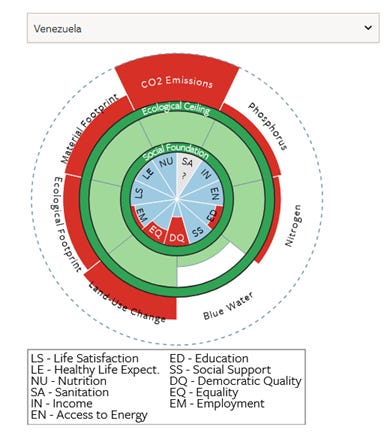
This is a graphic for the infamous Venezuela, which scores very low on the economic freedom index.
This the graphic for the United States, which scores high on economic freedom:
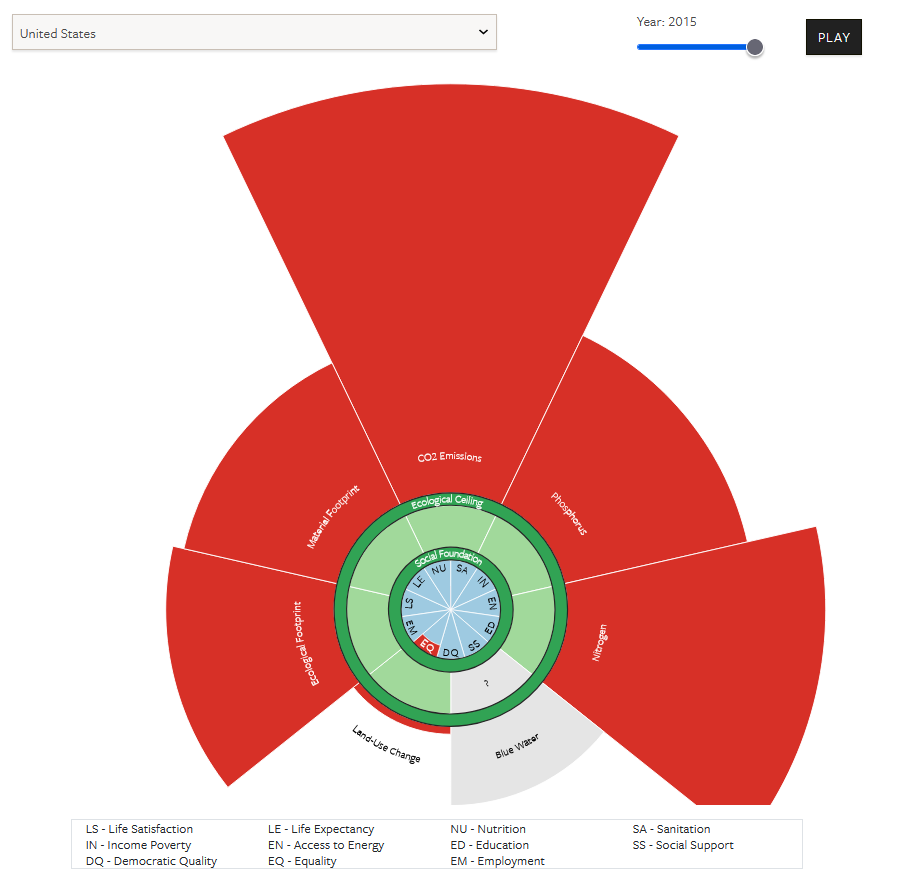
Anything in red is bad. It means the country, through its economic activity, has breached the limits of what Earth can provide and sustain.
(3) “Economic Freedom” Leads To Gross Abuses Of Human Rights, Decency, And Dignity
In the name of economic freedom, check out what is happening in the world:
· OpenAI used Kenyan workers on less than $2 per hour to make ChatGPT less toxic
· Abused, exploited, treated like ‘slaves’: the plight of Filipino farm workers in South Korea
· Manufacturing company ordered to turn over $1.5M in profits for child labor violations
Try a DuckDuckGo search for: “human rights abuses by corporations”.
(4) Corporations Are Not People!
In 2010 the United States Supreme Court decided that corporations have similar rights as individuals, and they can spend unlimited money in the name of free speech. This is the infamous Citizens United case. In this way, corporations were considered as having the same kind of free speech as individuals. Which is wrong from the get-go because a corporation is an abstract group of people. A corporation is a set of rules and contracts. A corporation is not a person. A corporation does not have one mouth and one brain to do free speech. A corporation is an inanimate, soulless logo. A logo cannot do free speech.
Since the Citizens United case, campaign spending by corporations and other outside groups increased by nearly 900% between 2008 and 2016. In 2020, total election spending was $14.4 billion, up from $5.7 billion in 2018, and more than $1 billion in dark money was spent. Do you think that corporations spending money in politics, in the name of freedom of speech, is a good thing? Do you think spending money in politics for your personal economic freedom is a good thing?
(5) Sustainable Development Has Created More Poverty And Suffering
Poor countries were told they have to “open up” to economic freedom. They were given so called “foreign aid” in order to become free. In 2012 developing countries received a little over $2 trillion, including all aid, investment and income from abroad. But more than twice that amount, some $5 trillion, flowed out of them in the same year. Drain from the South is worth over $10 trillion per year, in Northern prices, according to a study from 2022.
In the allegedly least economic free countries, who exactly is supposed to be free? The citizens of that country? The companies incorporated according to the laws of that country? Foreign companies operating in the country? Fraser Institute is dead silent on these specifics. Freedoms ought to be afforded to individuals, not to corporations, which are anti-democratic entities. This is why, if you frame economic freedom in the way Fraser Institute does, it is clear you mean economic freedom is not meant for everyone.
How To Spot Lies About Economic Freedom?
When you hear right-wing capitalist think tanks like Fraser Institute and its cohort of likeminded conspirators from the Atlas Network, stop for a second, and really listen to what they say. You hear them say “personal economic freedoms” but they do not mean your freedoms. They mean the “personal” freedoms of economic agents, namely, corporations.
Needless to say, a corporation is not a human, as the Citizens United decision suggested, but rather a group of humans with special interests. That might be fine at face value if it did not come with massive, totalitarian, undemocratic domination of the working class by the capital-owning class. Fraser and their buddies want economic freedoms for the owners of capital, but not for those who must obey them under the threat of unemployment and poverty. This is what makes the lies of Fraser immoral, simply because they are aware of the distinction between these classes of humans, and still demand more economic freedom for the oppressors.
How Would Real Economic Freedom Look Like?
We need economic democracy. There is nothing freer than an economic system that is fully inclusive and works for everyone, not just for the humans who own shares in companies. One human = one vote in all companies, without exception. Abolish unelected executives, and unelected boards. The freedom of association which gives you the right to form special groups of interests, like the shareholders of a corporation or the board of directors, should not create a class of oppressors and a class of oppressed. That is the opposite of freedom. Economic associations of people should not have more rights than individual humans, just because they are associations.
The so-called defenders of economic freedom manipulate the trinity of property-power-capital to serve their special interests by diving us into classes: employers versus employees, rentiers versus renters, owners versus workers. This is the very definition of capitalism.
We can do much better than this.