
Sufficiency as an anti-capitalist moral philosophy

I am a committed lefty and this is a leftist publication. I look at the economy holistically. I talk about money, power, hierarchies, energy and also about the fundamental causal design of our economic system. I write about how and why corporations and institutions are designed in the way they are. I look at both theory and practice. I do not just critique capitalism. I also introduce solutions and alternatives, some of which have been known for a long time, but have not been fully implemented on a large scale.
A lot of people know that something is really wrong with how we organize our economy. There are many different theories and interpretations. Marxists look at capitalism from the perspective of class relations – those who own the means of production versus those who don’t. Anarchists blame the state for perpetuating this unjust economic system. We even have supporters of capitalism doing their own critique. Many of them say that the economy is not doing great because corporations do not have enough freedom. If corporations had more freedom, they could make even more prosperity that can be shared with everyone.
Some economists look only at the flow of money, and they judge capitalism through the lens of public and private debt, or they look only through the lens of international trade. Others look at the economy through the lens of flows of energy. They see the global economy as a massive Superorganism comprised of people and institutions. They say the control over resources such as oil or lithium or land, determines how the economy moves, and determines everything else, including the state of geopolitics.
From a holistic perspective the bottomline is that the global economic system, in its entirety, has grown too much. We made the economy much bigger than what the planet can provide to sustain lifestyles that use so many resources and generate so much waste. This massive over-growth comes with massive injustice. Some humans benefit much more from this growth than others. The vast majority of humans continue to live in terrible poverty. Hundred of millions do not have access to clean drinking water. The big problem is that we cannot grow the entire economy even more in order to create prosperity for those left behind.
Sufficiency is the philosophy that can fix this. The basic idea is super simple. Those that have too much must change their ways and live with less stuff and less energy. Those that do not have enough should get more stuff and more energy to reach a decent standard of living.
The idea of sufficiency, which can also be presented as “having enough” or “enoughness”, has been discussed recently in the book Sufficiency: From Growth and Overshoot to Enoughness. The book gravitates around this formula I = A x T x P, which means that human-induced environmental impact is influenced by a mix of affluence, technology, and size of population. The population question, Are there already too many humans living on Earth, is a very sensitive question which is answered by some with No, and by others with Yes, or with It Depends. I am not going to talk about population in this video. I will rather focus on a specific table from chapter 4.
Direct quotes from the chapter: The ultrarich overconsuming class constitutes the richest 1% of the world population, with annual incomes above 220 000 Euros. The carbon footprints are estimated to be in the range of 200—320 tCO2e/capita per year. The overconsuming class is the richest 10% of the world population, living predominantly in North America and the EU, with incomes above 14 000 Euros. This class has average footprints around 20 tCO2e/capita per year. The consuming class constitutes almost a fifth of the global population. Incomes in the EU, North America, and other rich countries range from 6000 to 14 000 Euros. The carbon footprint of the consuming class is around 7 tCO2e/capita per year, close to the global average. The sufficiency class includes about one third of the human population. It refers to individuals with carbon footprints of up to 5 tCO2e/capita per year. This shifts attention from North America and the EU to lower-income regions. The vast majority of people in this class lives in developing or rapidly growing economies. The struggling class refers to a third of the global population that does not have its basic needs met, lacking essentials like safe and sufficient food, water, and shelter. The struggling class includes the poorest individuals, mainly living in sub-Saharan Africa, where 70% of the population belongs to this class. The struggling class is largest in developing countries. The 10% with the lowest income have carbon footprints around 0.1 tCO2e/capita per year and include countries like Honduras, Mozambique, Rwanda, and Malawi. Their footprints are 2000 times lower than that of top emitters. More than a billion of the poorest people have a purchasing power parity of less than USD 1.90 per day, with carbon footprints up to 1.9 tCO2e/capita per year.
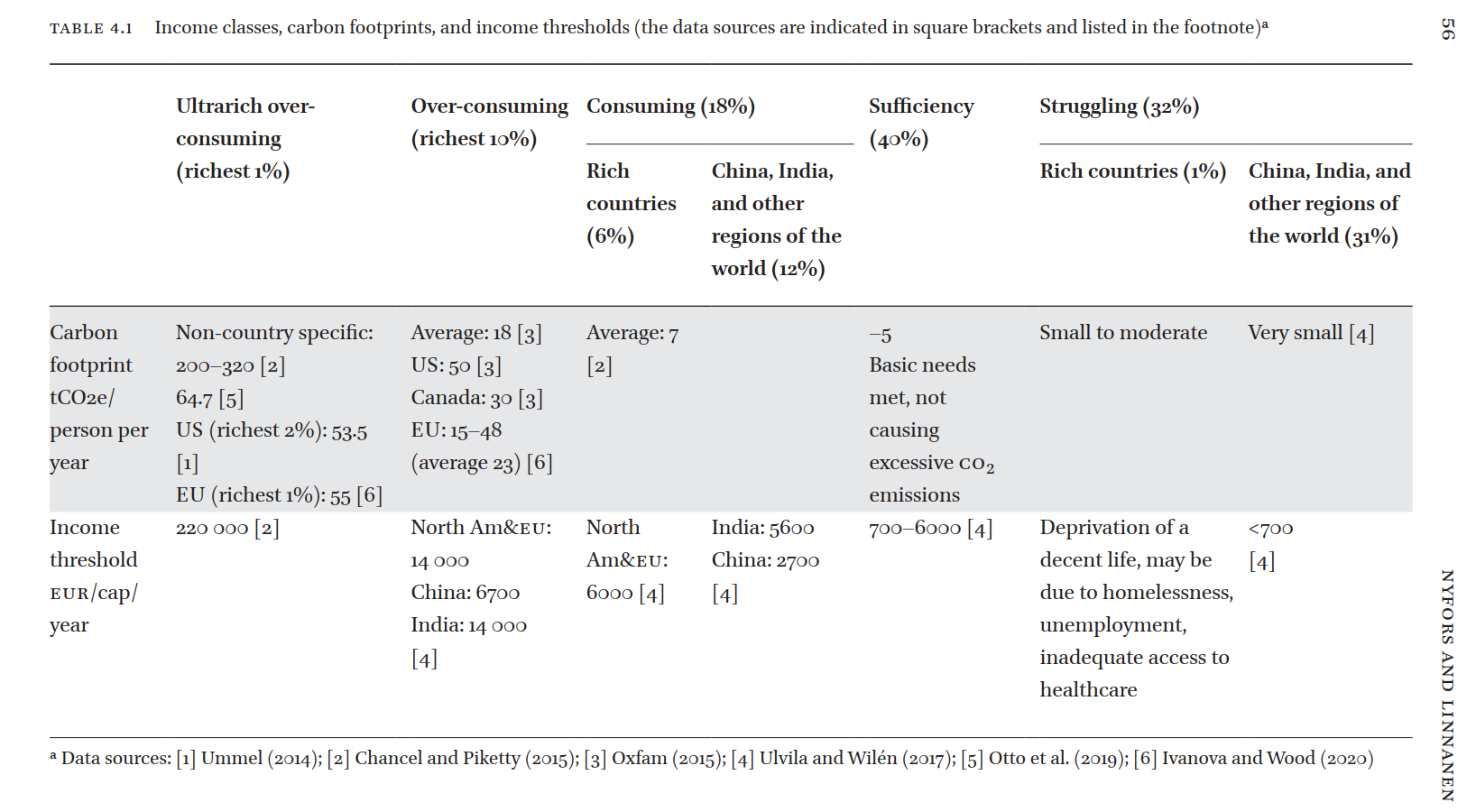
Okay, so these are some numbers that put sufficiency in a global context, according to categories of income and carbon emissions. Where does this idea of sufficiency come from and why these numbers?
Sufficiency comes from the idea that we need to balance our lifestyles with the limits of the planet. The most well-known research that quantifies the safe limits for human activities is the planetary boundary concept, which is described by this very famous image.
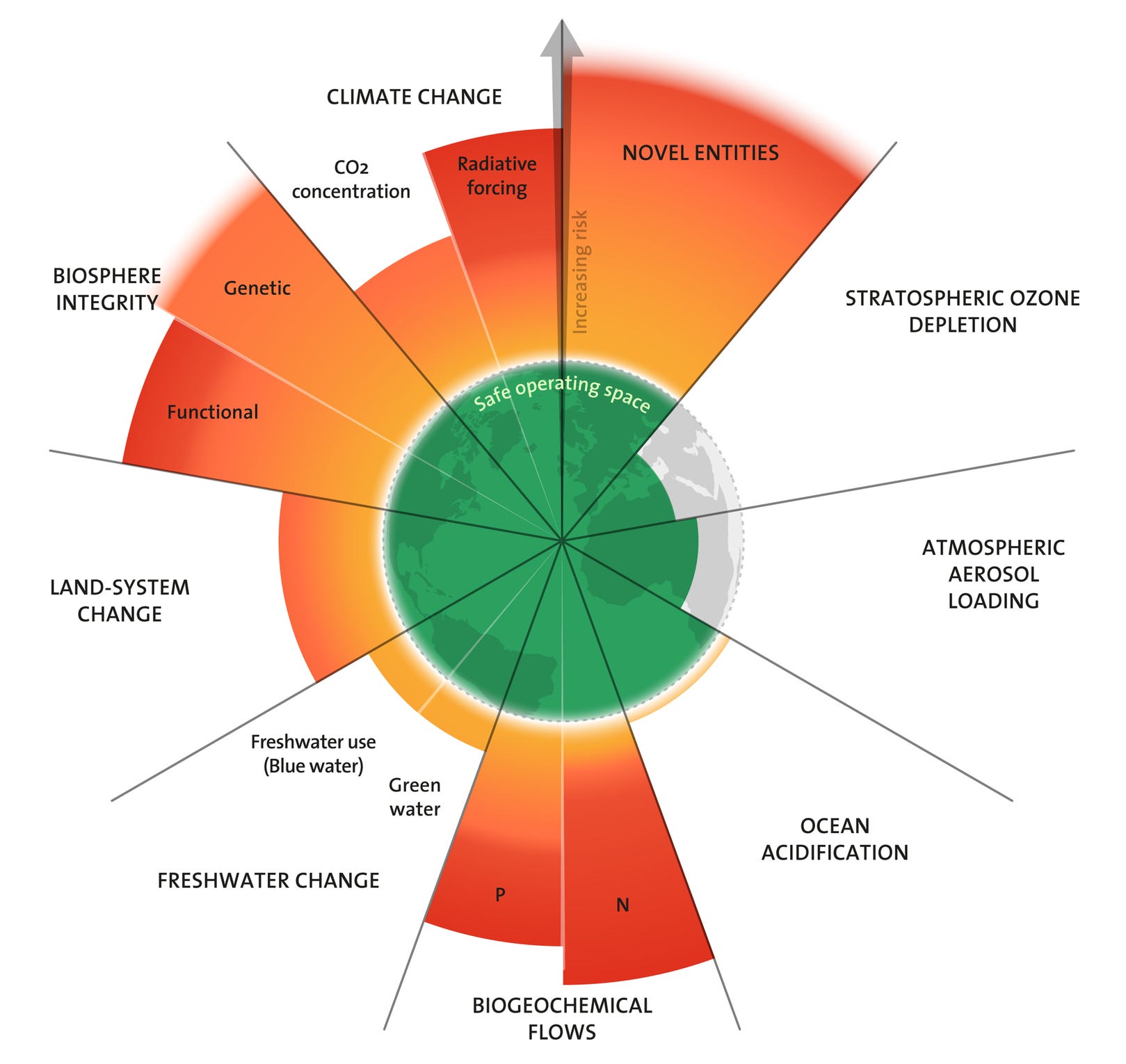
Here, we see that the limits for the safe operating space for humans, the green area in the middle, has been breached in seven of nine categories. We can see that climate change, which includes CO2 emissions, is only one of the seven limits that have been crossed. The sufficiency data that we saw earlier refers only to CO2 emissions. We have not talked about sufficiency regarding biosphere integrity, land-system change, freshwater change, biochemical flows, ocean acidification and novel entities.
Sufficiency describes how many resources we can use, how much CO2 we can emit to remain in the green area. That’s what the table above tells us. The full chain of causes goes like this: the design of capitalism has caused the breach of planetary boundaries. In order to survive we must fix the breach with degrowth to get to levels of sufficiency for all humans. This is how degrowth enters the picture. Degrowth provides the toolkit of how all the red in the picture can be reduced and eliminated. Degrowth is the proper diet that would change how we do economics.
As I have said before, the design of capitalism is utterly incapable of reducing the red. Capitalism is designed only to expand more and more. If we continue business as usual, all nine limits will be crossed, the red will become even larger, until all life is wiped out from the face of the planet. There is simply no way to use the same economic theory to fix the problems that were made by that theory in the first place! It’s like trying to put out a fire by throwing even more gasoline at it!
Mainstream economists, those that you see on CNN, BBC and business channels, do not analyze the economy from the perspective of planetary boundaries or sufficiency. To them, it’s all about efficiency, productivity, and profit. How can we make the economy green and make a profit from it. How can we reduce government spending and have a sustainable infrastructure. They will never ever tell you about the destructive design of capitalism that generates so much waste and so much abundance but only for a minority of humans.
Sufficiency is a philosophy and a way of life. It is a concept that allows humans to prosper in a qualitative way. Sufficiency recognizes that material excesses do not bring more satisfaction in life. Material affluence creates envy and enormous waste. Material affluence makes us want to keep up with the Joneses because chasing status with wealth is what the status quo demands. Sufficiency breaks this insane pattern of destructive behaviour. I suppose what is most interesting about sufficiency is that it normalizes a culture where having just enough is a superior moral position to take. Sufficiency makes it okay to shame people who live with enormous material excess and waste while billions are left behind. So, when I hear whatever celebrity or business guru talking about doing environmental sustainability or climate activism, I look at how much wealth they actually have, and if it’s more than a level of sufficiency, I will not listen to what they have to say and I write SHAME ON YOU on their pages. If they are willing to change their ways and help the cause of sufficiency, then we can work with them to help them give away their excess wealth for making an actual difference in the world instead of self-interested PR stunts.
I also said in an earlier video that lifestyle shaming is not good politics and that remains true. Shaming consumers and over-consumers does not really work if you want to get elected as a politician, but it can really work if it is done socially, outside politics. This is for as long as we have to put up with having elections instead of selecting representatives at random (like in jury duty or citizens assemblies). It is important to remember as well that consumption is a result of production, so all efforts to reach sufficiency must start at changing patterns of production first. To change production requires a careful political strategy, which I have talked about recently. Under no circumstances, focusing only on the behaviors of humans that consume too much, is going to save us, but it is part of the strategy.
You can read an interview with Toni Ruuska, on of the editors of the book, in the Sufficiency and Wellbeing Magazine. In fact I recommend you subscribe for free to the magazine and spread the word. The magazine is a collective effort, where writers peer review each other, where we develop trust, solidarity and community around the world, especially with people living already with sufficiency. If you feel like talking to us or writing with us, join our Discord server. Link below.
Here is some more data from the book to reflect on.
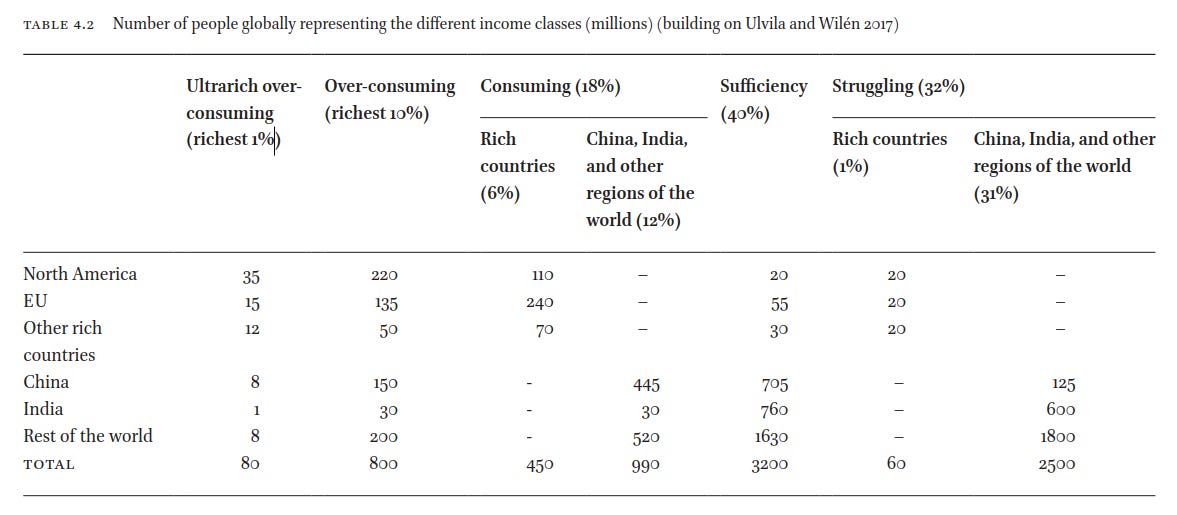
On the planet, 80 million humans are ultrarich overconsuming, 800 million are overconsuming, 1.444 billion are consuming, 3.2 billion are at sufficiency levels, and 2.560 billion are struggling. From a total population of 8.2 billion only 3.2 billion are in the right place. Think about that!
Astonishing numbers! It is the rich vs. the world.